Lithium Disilicate vs PMMA: How American Dental Labs Are Using Both Materials to Their Advantage

Dental labs running CAD/CAM production often treat lithium disilicate and PMMA dental materials as occupying separate and distinct positions in their workflow: lithium disilicate for esthetic pressed or milled final restorations, PMMA for temporaries. This framing is accurate as far as it goes, but it understates the ways in which experienced labs are using these two material categories in deliberate, coordinated ways that improve both clinical outcomes and production efficiency. Understanding the specific properties of each material, and the complementary roles they play across different stages of restorative dentistry, reframes the materials selection conversation from a binary choice to a workflow integration question.
Lithium Disilicate: Where It Remains the Gold Standard
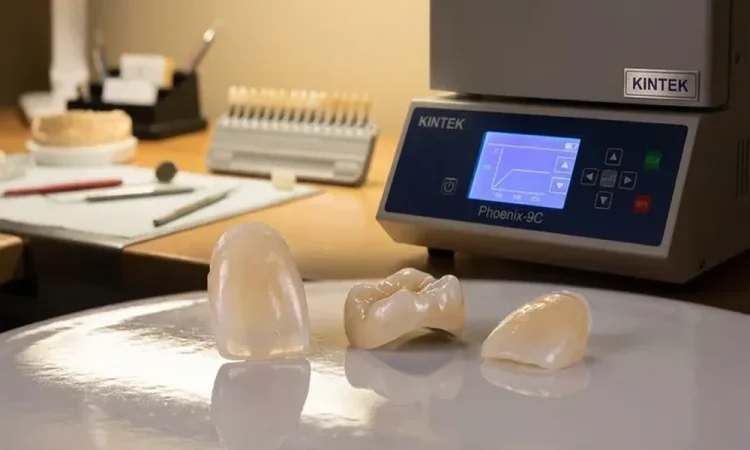
Lithium disilicate crown restorations remain the benchmark for single-unit esthetic anterior and premolar restorations where the combination of high translucency, natural fluorescence, and adequate flexural strength makes them the optimal material choice. Lithium disilicate’s optical properties allow light to interact with the restoration in a way that more opaque zirconia alternatives cannot match in the most demanding esthetic cases, producing a natural-looking result that satisfies patients who have specific esthetic expectations for their anterior dentition.
For pressed lithium disilicate crown fabrication, the pressing process produces a dense, homogeneous microstructure with consistent mechanical properties and minimal internal defects. Milled lithium disilicate, crystallized after milling, offers the design flexibility of CAD software alongside the material’s excellent esthetic properties. Both routes produce restorations with flexural strengths in the 400 MPa range, adequate for single units and short-span anterior bridges in most occlusal environments.
PMMA Dental Material: The Underutilized Asset in Clinical Workflow
PMMA dental material is almost universally stocked by US dental labs that produce provisional restorations, but the depth of its clinical utility is frequently underexploited. A high-quality pmma dental provisional restoration does more than fill space while a final restoration is fabricated. It validates the planned esthetic outcome before the irreversible step of cementing the definitive restoration, confirms the occlusal scheme, allows the patient to evaluate and report on phonetics and comfort, and gives the clinician the opportunity to refine contours and shade before committing to the final material.
Aidite clear PMMA and multilayer equivalents take this validation role further by producing provisional restorations whose shade graduation more accurately represents the planned final zirconia or lithium disilicate outcome, reducing the aesthetic surprise factor that inadequate provisionals sometimes create when the definitive restoration is delivered.
The Full-Arch Context: Where Both Materials Work Together
Full-arch restoration cases, both implant-supported and tooth-supported, represent the clinical context where the coordinated use oflithium disilicate and PMMA dental material produces the most significant workflow efficiency gains. The full-arch provisional in PMMA, used to validate vertical dimension, occlusal plane, esthetic parameters, and phonetics over an extended period of patient wear, gathers the clinical intelligence that the final restoration’s design depends on. The definitive restoration in lithium disilicate or full-contour zirconia is then fabricated with confidence that the design parameters have been verified in the patient’s actual oral environment rather than estimated from study models and photographs alone.
Sourcing Consistency Across Both Material Categories
For US dental labs building workflows that depend on predictable, coordinated performance from both lithium disilicate and PMMA dental materials, sourcing both from a supplier with domestic inventory and consistent batch quality provides the supply chain reliability that high-volume production requires. Lot-to-lot variation in PMMA shade or lithium disilicate crystallization behavior creates the kind of production unpredictability that high-performing labs actively work to eliminate from their workflows.
____________________________________________________________________________________