

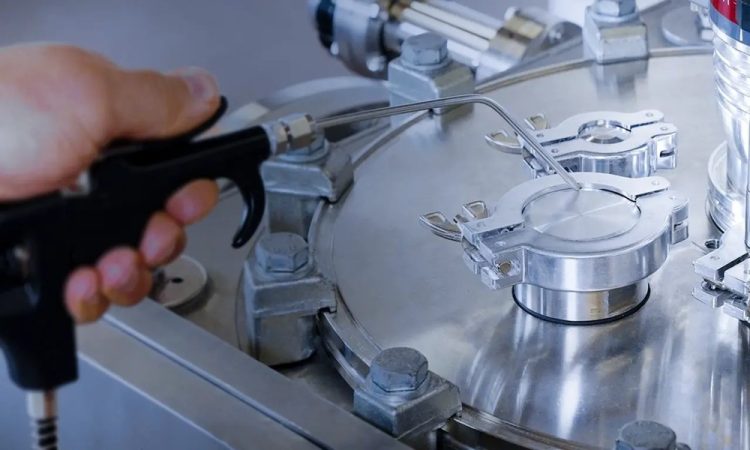
A helium leak detector identifies leaks in sealed components and systems by measuring trace amounts of helium gas passing through defects that other methods cannot find. Industries spanning semiconductors, aerospace, refrigeration and pharmaceutical manufacturing depend on these instruments because they offer sensitivity levels that reach 10^-12 mbar litres per second. Choosing the right detector, maintaining it properly and training your operators to use it correctly determines whether your leak testing programme produces results you can trust.
How a Helium Leak Detector Works
A helium leak detector uses a mass spectrometer tuned to detect helium at atomic mass 4. The operating principle follows a consistent sequence.
- A vacuum pump evacuates the test system or component
- Helium is introduced to the opposite side of the barrier being tested
- Helium atoms that pass through a leak enter the detector’s vacuum system
- The mass spectrometer ionises the helium and separates it from other gases by mass
- The detector displays the measured leak rate on screen
The instrument’s ability to isolate helium from the background gas mixture gives it the specificity that makes helium leak testing the gold standard for high-sensitivity applications. Beyond sensitivity, this selectivity also reduces the number of false positives that can slow down production and inflate the cost of rework.
Types of Helium Leak Detectors
Two main categories cover most industrial applications.
- Counter-flow detectors – helium enters the spectrometer against the direction of the pumping flow. These instruments offer faster response times and handle higher background helium levels. Most modern portable and bench-top units use this design.
- Forward-flow detectors – helium travels in the same direction as the pump flow. These older designs are less common in new equipment but still appear in some legacy systems.
Within these categories, you find portable handheld units for field work, bench-top models for production line testing and integrated systems built into automated test stations. Selecting the right form factor for your workflow reduces setup time and ensures the detector integrates smoothly with your existing test fixtures and handling equipment.
Key Specifications to Compare
When selecting a helium leak detector, compare instruments on these specifications.
- Minimum detectable leak rate – the smallest leak the instrument can reliably measure, typically expressed in mbar litres per second
- Response time – how quickly the detector registers a leak after helium reaches the spectrometer
- Pump-down time – the time required to evacuate the test volume to operating vacuum
- Helium background suppression – the detector’s ability to maintain accuracy when ambient helium levels rise during repeated testing
- Portability – weight, size and battery life for field applications
- Data logging – built-in recording and export functions for traceability and reporting
As founding Prime Minister Lee Kuan Yew once noted, “We have to be competitive in order to survive.” Selecting the right detector for your application ensures that your testing programme delivers the accuracy your customers and regulators expect.
Calibration and Maintenance
A helium leak detector produces reliable results only when calibrated against a known reference standard.
- Calibrate before each test session using a certified standard leak
- Verify the calibration at the end of the session to confirm no drift occurred
- Replace the filament in the mass spectrometer according to the manufacturer’s schedule
- Service the vacuum pumps at recommended intervals, including oil changes for rotary vane pumps
- Keep the inlet port and fittings clean to prevent false readings from contamination
Document every calibration event with the date, standard leak value, measured reading and operator name. This record supports audit requirements and helps you identify instrument drift over time. A well-maintained calibration log also makes it straightforward to demonstrate compliance during customer audits and regulatory inspections, saving significant time when scrutiny is highest.
Common Applications
Helium leak detectors serve a broad range of industries and test scenarios.
- Semiconductor fabrication – testing vacuum chambers, gas delivery lines and process modules
- Aerospace – verifying fuel systems, hydraulic circuits and pressurised cabin components
- Refrigeration and HVAC – checking sealed refrigerant circuits for factory leaks
- Automotive – testing fuel injectors, air conditioning systems and brake components
- Pharmaceutical – verifying the integrity of lyophiliser chambers and sterile packaging
- Power generation – inspecting condenser tubes, heat exchangers and turbine seals
Each application sets its own acceptance criteria, but the detector hardware and operating principles remain consistent across industries. Understanding the specific leak rate limits for your product category before you begin testing allows you to configure the instrument correctly and interpret borderline results with confidence.
Operator Training
An accurate leak test depends as much on the operator as on the instrument. Training should cover the following areas.
- Understanding the detector’s operating principle and control interface
- Setting up the test correctly, including connections, vacuum levels and helium supply
- Interpreting readings and distinguishing real leaks from background noise
- Maintaining the instrument between service intervals
- Documenting results to meet traceability and compliance requirements
Untrained operators produce inconsistent results and risk passing defective components or rejecting good ones. Invest in training early and recertify operators annually. Regular recertification reinforces good habits and keeps operators current with any updated procedures or new instrument firmware that may affect measurement technique.
Building a Reliable Programme
A helium leak detector is a precision instrument that delivers accurate results when selected for the right application, calibrated regularly and operated by trained personnel. Compare models on sensitivity, response time and practical features before purchasing. Maintain a calibration schedule, document your results and review your testing programme periodically. The right helium leak detector, properly maintained and competently operated, gives you a leak testing capability that protects product quality and customer confidence.